Israeli strike in al-Tiri kills veteran reporter Amal Khalil
The attack occurred one month after a ceasefire was established, killing Khalil and injuring photojournalist Zeinab Faraj in southern Lebanon.
By Edward Lawson ·
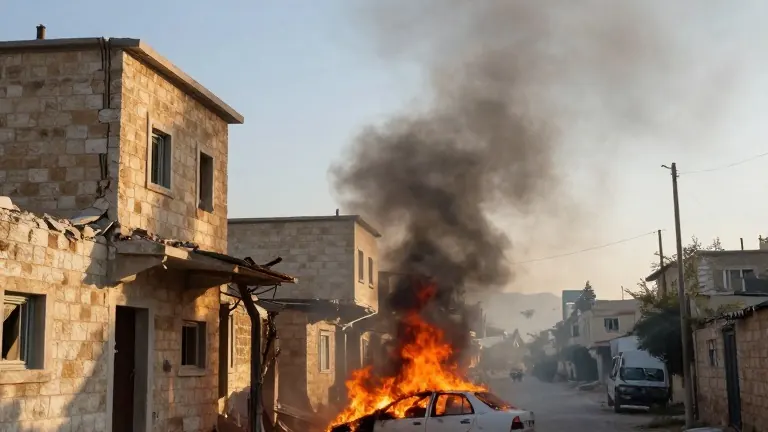
Amal Khalil died in the village of al-Tiri in southern Lebanon following a missile strike on 22 April. The attack occurred approximately one month after Israel agreed to a ceasefire with Lebanon. Faraj, a 21-year-old photojournalist, survived the same strike and was trapped under rubble for an extended period before rescue.
Khalil, a 42-year-old newspaper reporter, had been working with Faraj on an assignment to document the war's aftermath. The two women traveled to the area to capture footage and assess the damage. They were accompanied by Ali Nabil Bazzi, a 27-year-old municipal official, and Mohammed Hourani, a 37-year-old friend of the mayor. The group had met earlier that day at Tebnine governmental hospital, which served as a staging point for civilians returning to their homes.
The first missile struck the car carrying Bazzi and Hourani, setting it on fire. Khalil and Faraj exited their vehicle to assess the situation. Faraj attempted to approach the burning car to locate Bazzi. Khalil observed the bodies of the two men in the front vehicle. As the women made emergency calls, drones appeared overhead and flew at low altitudes. Paramedics on the line instructed the pair to drive away because ambulances could not reach their position.
As Khalil and Faraj attempted to re-enter their car, a second missile struck the vehicle. The impact threw both women backward. Khalil sustained visible injuries to her face, hand, and leg. The two took shelter in a nearby house. Faraj sent a final text message to her sister stating that there was no hope left. While inside, Faraj crawled to a position where she could monitor the road. A drone descended toward her, and a subsequent missile strike caused the building to collapse.
Faraj was pinned under rubble in the dark. She lost consciousness briefly but regained awareness when a paramedic reached the scene. The paramedic stayed with her until a second worker cleared the debris. Drones returned to the area as the rescue team pulled Faraj from the wreckage. Faraj was transported to a hospital where she learned of Khalil's fate. Medical staff fell silent when asked about Khalil, confirming her death. Khalil is believed to have died approximately one hour before paramedics were authorized to re-enter the strike zone.
The Israeli military identified the target as saboteurs violating the ceasefire. Human rights groups classified the incident as a war crime. The military received messages urging them to permit a rescue operation while the journalists were sheltering in the building. A week prior to the attack, an Israeli military spokesperson labeled a video of Khalil published by her newspaper as terrorist media. Khalil had also received death threats from Israeli numbers.
Faraj is currently preparing to return to university to finish her degree in radio and television. She suffers from a limp and has visible injuries to her hand and face. An injury to her face restricts the movement of one eyebrow. She reports waking at night screaming and reacting to the sound of aircraft. Faraj remains haunted by the image of Hourani lying on the ground after the first strike, with his eyes open and directed toward her.
Source: The Guardian